How CRS Uses AI-Powered Contents Inventory to Close Claims Faster
Every adjuster who has worked a residential fire or water loss knows the feeling: the structural scope comes together reasonably fast, but the contents side drags for days, sometimes weeks. Crews manually cataloging hundreds of items room by room, handwriting box labels, typing descriptions into spreadsheets. The homeowner is in a hotel. The carrier is waiting on a number. And the contents list is still not done.
This is not a staffing problem. It is a process problem. And it is one that AI-powered contents inventory is starting to solve — at least for the restoration companies willing to invest in the technology.
Content Recovery Specialists (CRS) is one of them. Across our franchise network, CRS has integrated ContentsPal — an AI-powered contents inventory and reporting platform into our standard packout workflow. The result is a measurably faster process, more detailed documentation, and a total loss reporting capability that gives adjusters something they rarely get quickly: a priced-out, line-item contents report ready to act on.
Digital Tech Over the Years: The Long Road to Efficiency
To understand where we are, you have to remember where we started. The evolution of inventory management has moved through three distinct waves:
The Manual Era
This was the age of digital cameras and SD cards. We took photos, drove back to the office, manually uploaded them to a computer, and then spent hours (sometimes days) hand-writing spreadsheets. If you had ten pairs of jeans, you wrote “jeans” ten times. It was a logistical nightmare where files could be lost as easily as an SD card could be misplaced.
The App Era
The first big shift came with mobile apps and tablets. We could finally take photos directly into a system, which was a huge step forward for organization. However, the labor was still intense. Every model number, serial number, and item description had to be typed out by hand on a touchscreen. It was better, but it was still slow.
The AI Era
The third wave is where we are now, and the leap is significant. Modern AI-powered contents packout technology changes the core workflow: take a photo, and the system generates the item description, category, quality, and condition details automatically without manual entry.
Here’s a real example of what that output looks like:
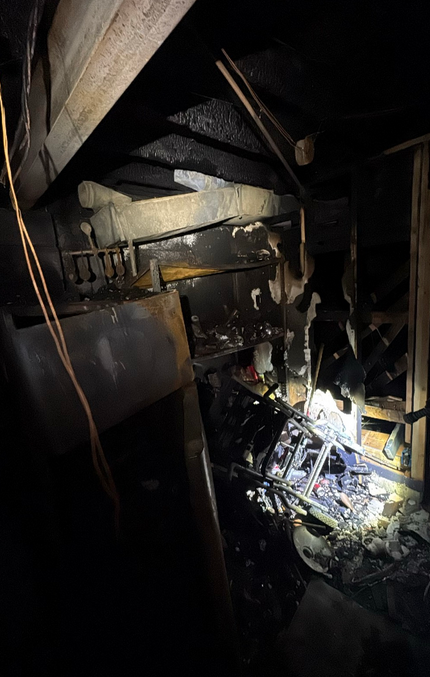
“Significant fire and smoke damage to kitchen structure and contents, with visible charring on walls, ceiling, and debris on the floor.“
That level of detail used to require a trained technician to type it manually, item by item, for every single thing on a job. AI generates it in seconds and it generates it consistently, regardless of what time it is, how long the crew has been on site, or how many hundreds of items are still left to document.
AI-Powered Contents Inventory: How the Technology Actually Works
For those who want to understand the technology beneath the workflow, AI-powered contents inventory uses computer vision, the same class of technology that powers facial recognition, self-driving vehicle perception, and medical imaging analysis applied to the specific domain of household and commercial items.
When a crew member photographs an item, the model analyzes the image and runs it against a trained catalog of objects. It identifies not just the general category (“coffee maker”) but often brand identifiers, approximate model vintage, and material characteristics that affect replacement value. This identification happens in real time, on the device, without requiring manual input from the crew member.
The pricing layer is a separate function. Once an item is identified and categorized, the platform queries vendor data sources across thousands of retailers to find comparable replacement items. It returns a price range and a median value, contextualized for current market conditions — not a static replacement cost schedule that may be a year out of date.
How CRS Uses ContentsPal in the Field
In the video above, a CRS franchisee walks through what using ContentsPal looks like in a real packout operation. The contrast with the old way is immediate.
Previously, crew members worked room by room with handheld cameras and either physical clipboards or a more traditional software interface that required significantly more manual data entry per item. It was functional, but it was slow and it was only as detailed as the crew had time and patience to make it.
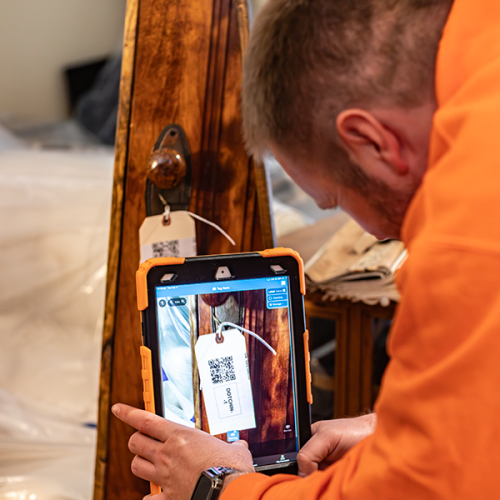
With ContentsPal integrated into the workflow, the pace changes. The crew moves through a room with a smartphone, snapping photos of items as they pack. The AI identifies what it sees and populates the inventory fields automatically. QR-coded box labels replace handwritten ones, and every item is tracked to a specific box and room from the moment it is packed. Nothing has to be reconstructed from memory at the warehouse.
What This Means for Adjusters and TPAs
If you are an adjuster or TPA, your primary interest in the packout is documentation and defensibility. You need to know what was taken, what condition it was in, whether it is restorable or a total loss, and what it will cost to replace if it is not. You also need that information quickly, because the contents line item is often what keeps a claim from closing.
Here is what working with a CRS location that uses ContentsPal means in practical terms:
You get a digital inventory, not a pile of photos. Every item is cataloged with a description, room of origin, box assignment, and condition tag. This is not a folder of JPEGs, it is a structured record that is searchable and auditable.
You get a priced-out total loss report. For non-restorable items, ContentsPal generates a replacement cost report using real-time pricing data from actual vendors. That report can go to both the carrier and the homeowner. As one CRS franchisee noted: “Both for the adjuster and the homeowner, they’re able to kind of settle that portion of the claim a lot quicker.” That is the goal.
You get reports formatted for your workflow. ContentsPal outputs Xactimate-compatible reports as well as custom PDF and spreadsheet formats. You are not waiting for someone to manually transpose an inventory into a format your system can process.
You have a chain of custody you can trust. The QR-coded tracking system means you can verify what items were packed in which box, when they were moved, and where they are in the storage facility. If a homeowner has questions about a specific item during the restoration period (and they always do) there is a documented answer.
You can access it without a phone call. The stakeholder portal gives authorized parties visibility into the job without requiring a call to the branch. For adjusters managing multiple active files, that is not a small convenience.
Faster Packouts Mean Faster Claim Cycles
When the inventory is completed faster, the adjuster gets the documentation package sooner. When the adjuster gets the documentation sooner, the contents line item can be negotiated and settled before the structural scope is still being finalized. When contents settles faster, the homeowner has one fewer open question during what is already one of the more stressful periods of their life.
Restoration companies often talk about the homeowner experience as a proxy for claim satisfaction. That relationship is real. How smoothly the packout goes, how clearly items are documented, and how quickly the inventory report arrives in the adjuster’s inbox all contribute to the homeowner’s perception of how the claim is being handled. CRS’s use of ContentsPal is designed to make that experience faster and clearer at every step.
From a TPA standpoint, the efficiency argument is even more direct. Faster cycle times across a portfolio of managed claims translate to lower carrying costs, reduced supplemental activity, and better network performance metrics. A contents company that consistently delivers digital inventories with pricing already built in is operationally simpler to manage than one that delivers a PDF of photos three days after the packout is done.
Why CRS Embraces Technology While Others Watch
There are contents companies across the country that are still processing inventories the same way they were ten years ago. Clipboards, cameras, spreadsheets, and a lot of crew hours. That approach still produces a result — eventually — but it is not competitive with what is possible using AI-powered tools, and it leaves money on the table for everyone involved: the restoration company, the carrier, and the homeowner.
At CRS, we lead with technology, not follow. That orientation toward technology, toward efficiency, toward the adjuster’s need for fast and accurate documentation, is what differentiates CRS as a contents partner. The packout is not the end of the job. It is the beginning of the claim. And how well it is documented determines how smoothly everything that comes after it goes.